
PGE's Oak Grove Hydroelectric Project
D
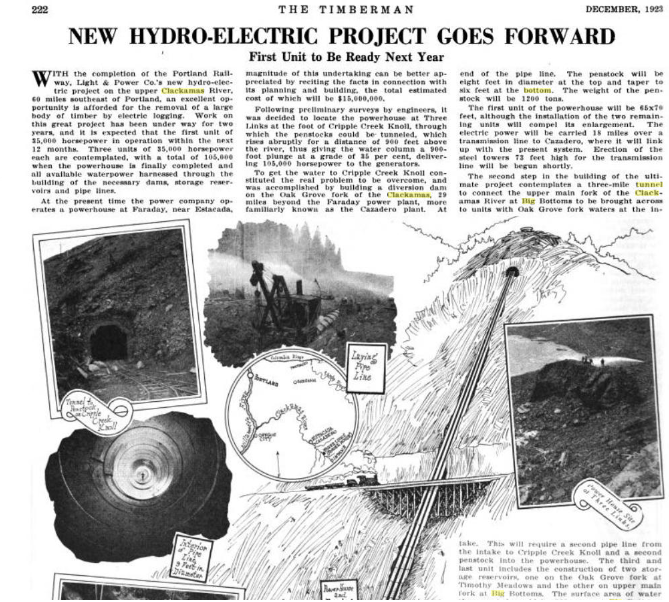
Wow, Kirk, you've been busy doing research! These are good finds. Thanks for posting them. It's sobering to think what the Clackamas country would be like today if Big Bottom and other dams had been built as planned.
R
That OHS page has a TON of photos of the Oak Grove project. I'm still wading thru them....
I'd really love to know which end of the tunnel they started - the north end or the south end? And if so, WHERE did it start? It would seem if you knew roughly the area it was it shouldn't be that hard to find, unless they filled the entrance in.... My rough calculations say it would be a LEAST 5 miles from Big Bottom to Harriet Lake - but maybe that isn't the route they were going to take?
D
I heard that they started the tunnel at the north end somewhere near Harriet Lake.
There are lots of interesting photos in that OHS collection. I am curious about the ones taken at Elk Lake. I wonder if they were thinking of building a dam at the outlet to increase the size of the lake to augment flows in the Collawash for power generation downstream on the Clackamas. There's a good photo of the ranger station at Elk Lake which I hadn't seen before. That's a keeper.
K
Bryon mentioned that the tunnel was started at Lake Harriet. https://www.trailadvocate.org/sf-forum/historical-items-of-interest/pges-oak-grove-hydroelectric-project/#p4506
It makes sense that they started at the north end since they had infrastructure there already. There's a picture at the Oregon Historical Society page that shows some guys near the tunnel entrance. https://digitalcollections.ohs.org/oak-grove-tunnel-party-of-officials-at-northern-portal
That tax case mentioned the length of the planned tunnel at around 20,000 feet. I seem to remember seeing an estimate of 19,xxx feet. Can't remember where I read that.
K
https://digitalcollections.ohs.org/oak-grove-project-intake
I think they must have reversed this negative. It seems like it's backward to me.
B
I drew a line in Google Earth to get an idea if the 20,000 ft. length is real. Sure enough, it could come out just below Big Bottom. At the time of this drilling, there was no road to that part of the river, so they would have started where they could get equipment to, Harriet Lake. What surprised me is that there is little elevation difference between the two ends, at water level according to Google Earth only around 25 ft. In the picture, the red line is my assumed tunnel route at 19978 ft. It could be shorter or longer but if its close to 20,000 ft. it shouldn't change much.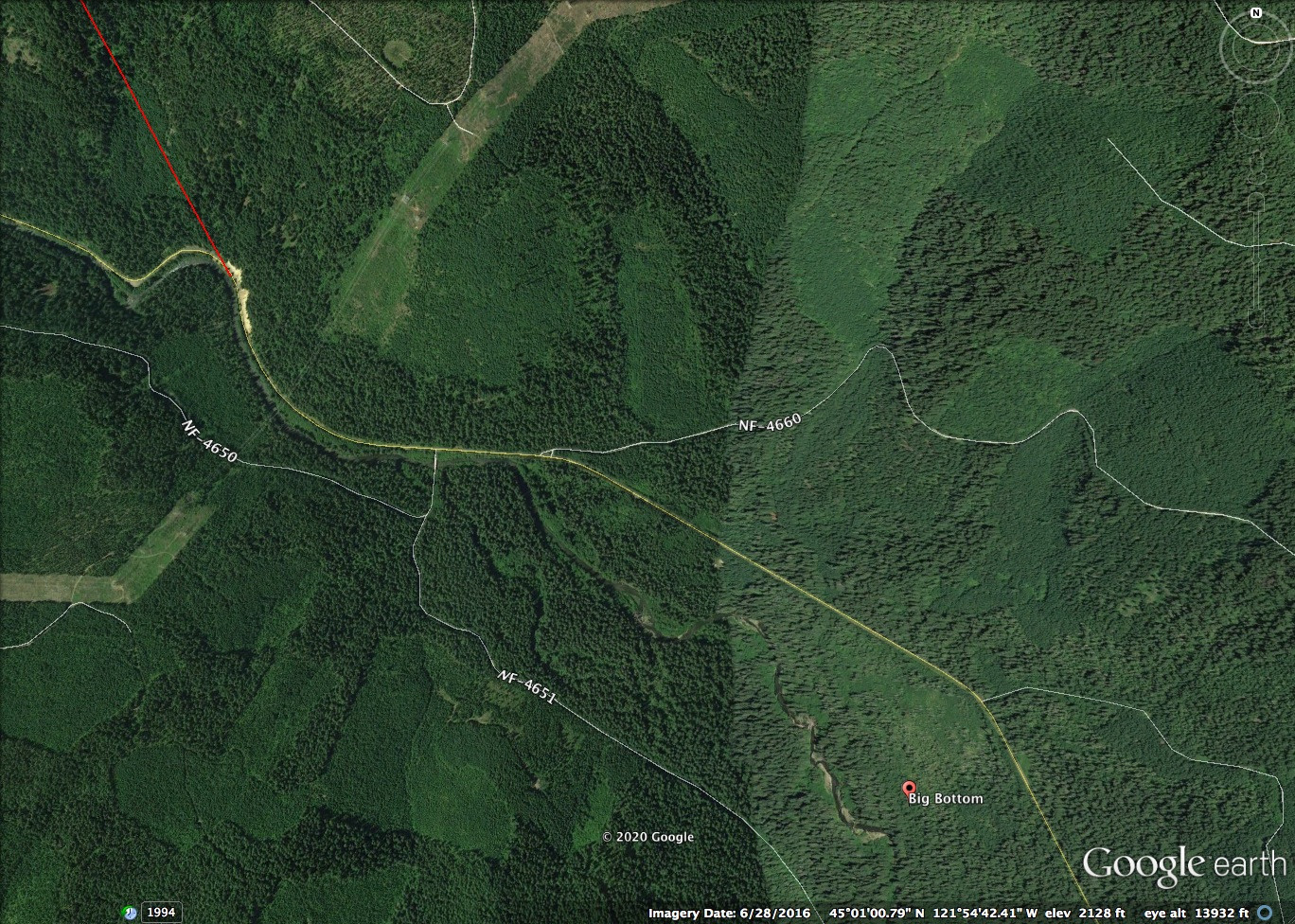
R
I've been looking thru all of those photos on the OHS site and am planning on putting a bunch of them on the Historical page. When going thru the photos, I saw a few names I hadn't heard before and wondered if anyone knew anything about them:
- Davis Ranch - was this where the Oak Grove Ranger station was? It kind of looks like it
- They talk about the "intake" - I'm assuming that has to be Harriet Lake, correct?
- I'm assuming when they refer to the "North Fork" they are referring to the Oak Grove fork of the Clackamas?
- I'd love to see a map where each of the camps were located - has anyone seen anything like that?
D
Davis Ranch and Oak Grove Ranger Station were two different places, according to the 1916 USGS Estacada map:
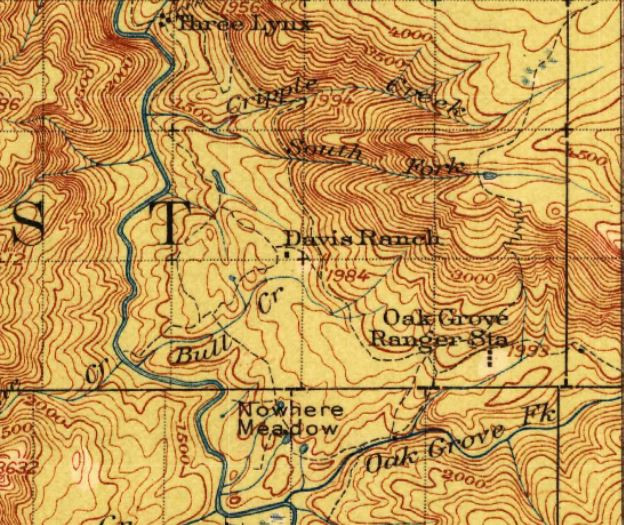 That's all I know about it.
That's all I know about it.R
Thanks Dave - I hadn't thought about looking at the old maps. That still looks like that area is privately owned - the current maps still show an in holding there.
I also noticed on a different 1916 map, they show "Intake" where Harriet Lake is:
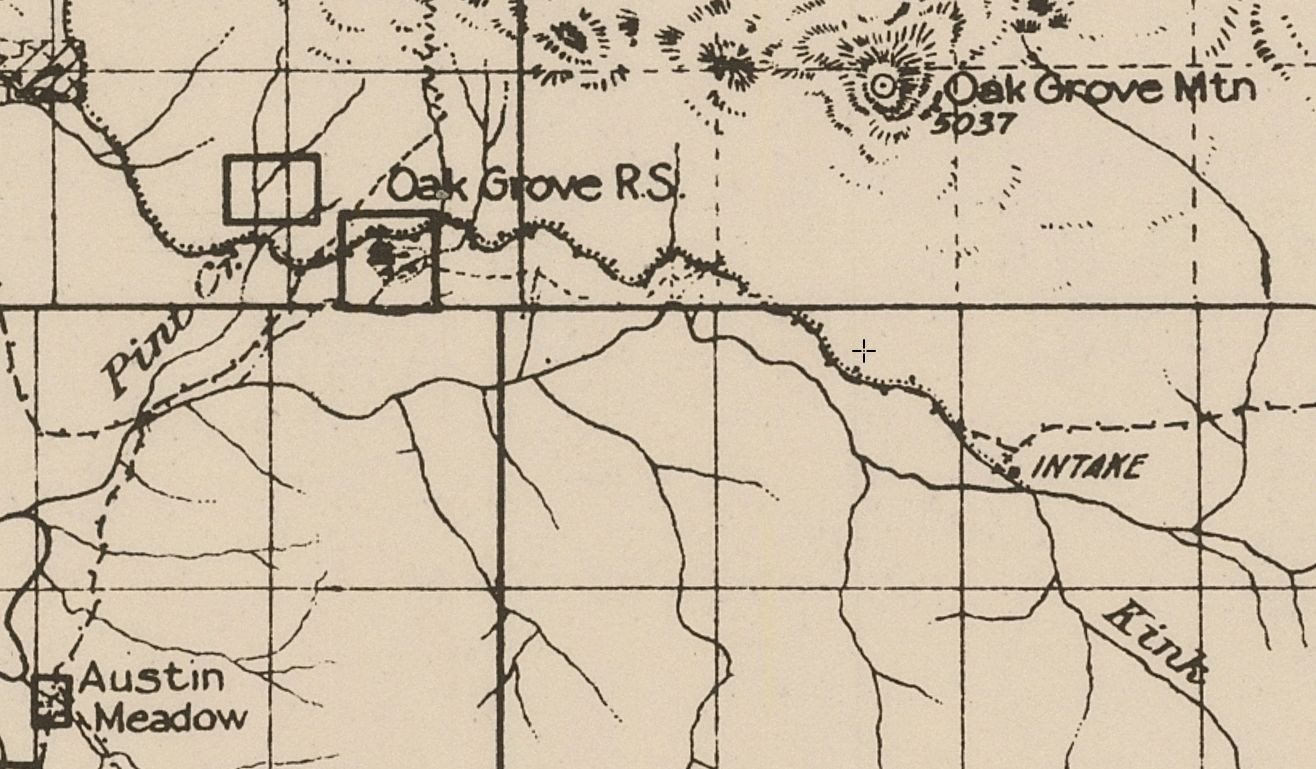 All the maps I see show the Oak Grove Fork as the Oak Grove Fork - so I'm still curious what fork they are talking about when they say the "North Fork"
All the maps I see show the Oak Grove Fork as the Oak Grove Fork - so I'm still curious what fork they are talking about when they say the "North Fork"D
Rob, you should take a look at the history of PGE on the Clackamas. Most of your questions are answered there. It mentions Davis Ranch, the general locations of several work camps (no maps), and the North Fork project. It says that exploratory work for the North Fork project, above Cazadero, began in 1906 but was not actually constructed until the 1950s. Those guys were busy all up and down the Clackamas a hundred years ago, from Estacada to Big Bottom to Timothy Meadows! Those OHS photos are a great addition to the narrative.
R
Doug Firman said Rob, you should take a look at the history of PGE on the Clackamas. Most of your questions are answered there. It mentions Davis Ranch, the general locations of several work camps (no maps), and the North Fork project. It says that exploratory work for the North Fork project, above Cazadero, began in 1906 but was not actually constructed until the 1950s. Those guys were busy all up and down the Clackamas a hundred years ago, from Estacada to Big Bottom to Timothy Meadows! Those OHS photos are a great addition to the narrative.Thanks, Doug. Sometimes I should probably think more before I post. 🙂 Obviously when they are taking North Fork, they are talking the North Fork Reservoir. I was just thinking about the Oak Grove project only. Thanks for the reminder on that document, I had forgotten about it. It is very good. I will digest it more thoroughly.
D
There's also a bit of info about Davis Ranch of page 64 of the book "Estacada." Doesn't give it's precise location, saying that it was a 160-acre homestead located between Three Lynx and Austin Hot Springs. Chapter Four, "We Have Power," starting on page 49, has some interesting photos of the development of power projects on the Clackamas.
S
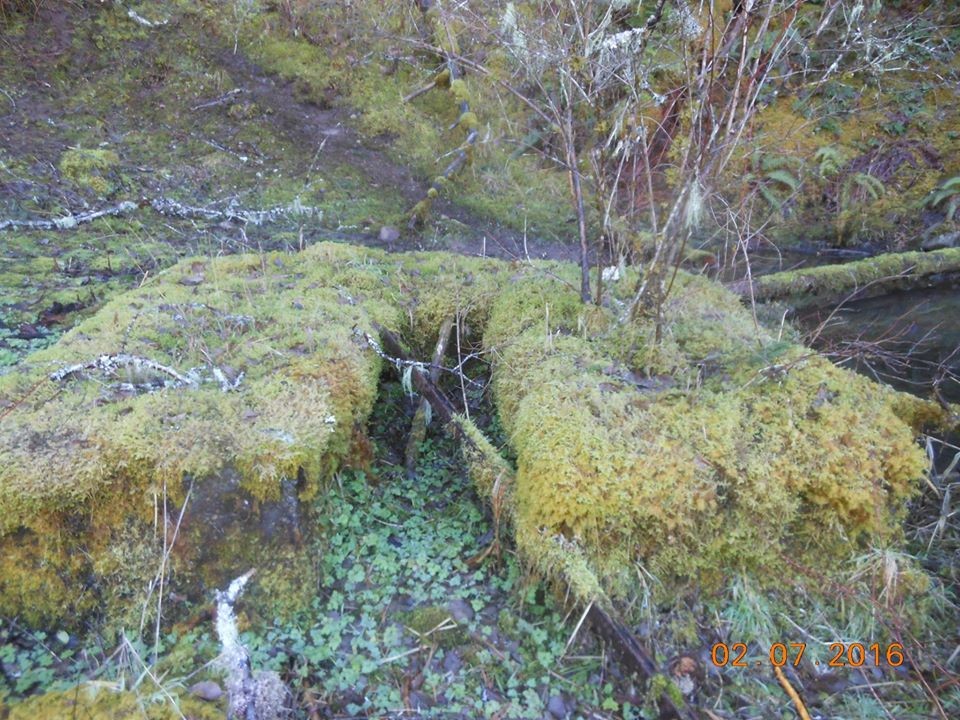
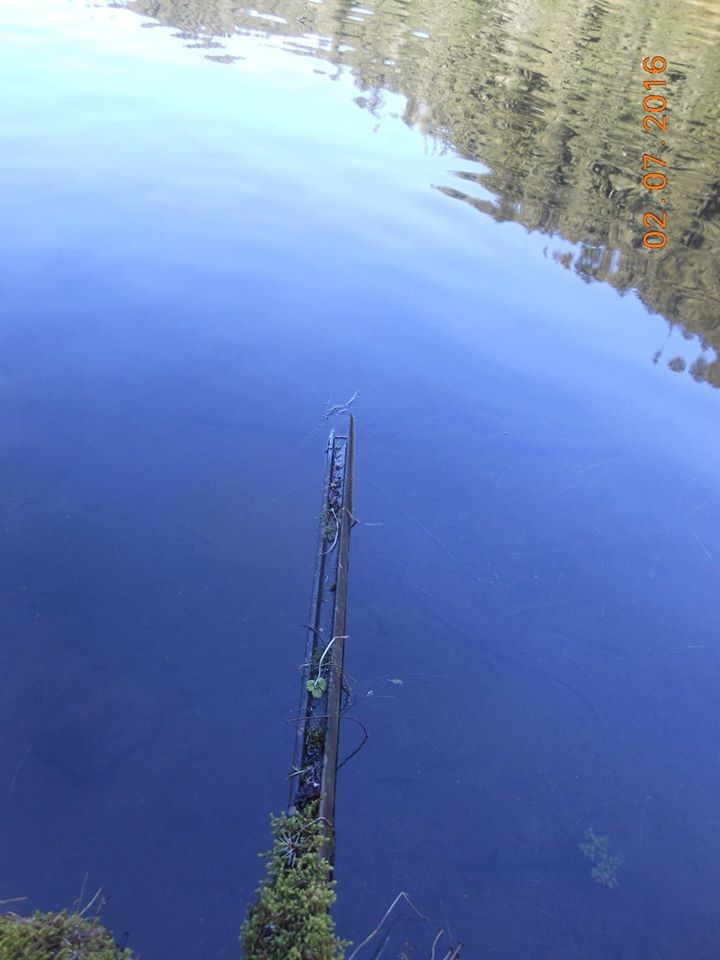
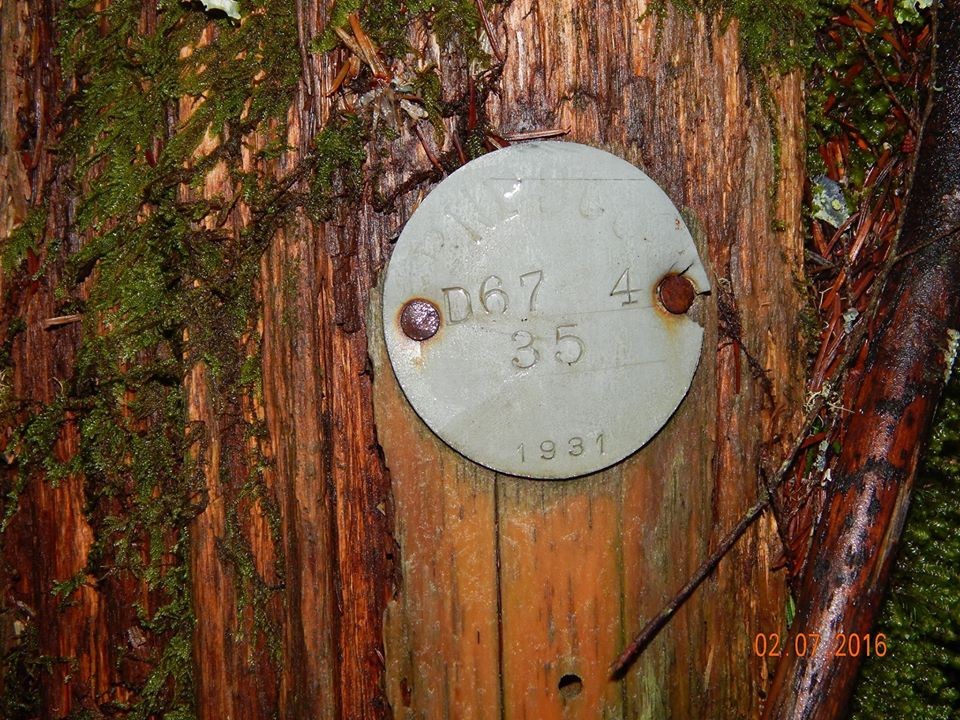
We went out there a few years ago to search out the tunnel and hiked down from the road. It's filled in at the lake, but there are still cart tracks and ventilation pipes there. If you stand on the fish platform, there is a concrete block on the other side of the lake. It has an ore cart track going into the lake. 4th pic is of a pole we found on the hillside above the lake.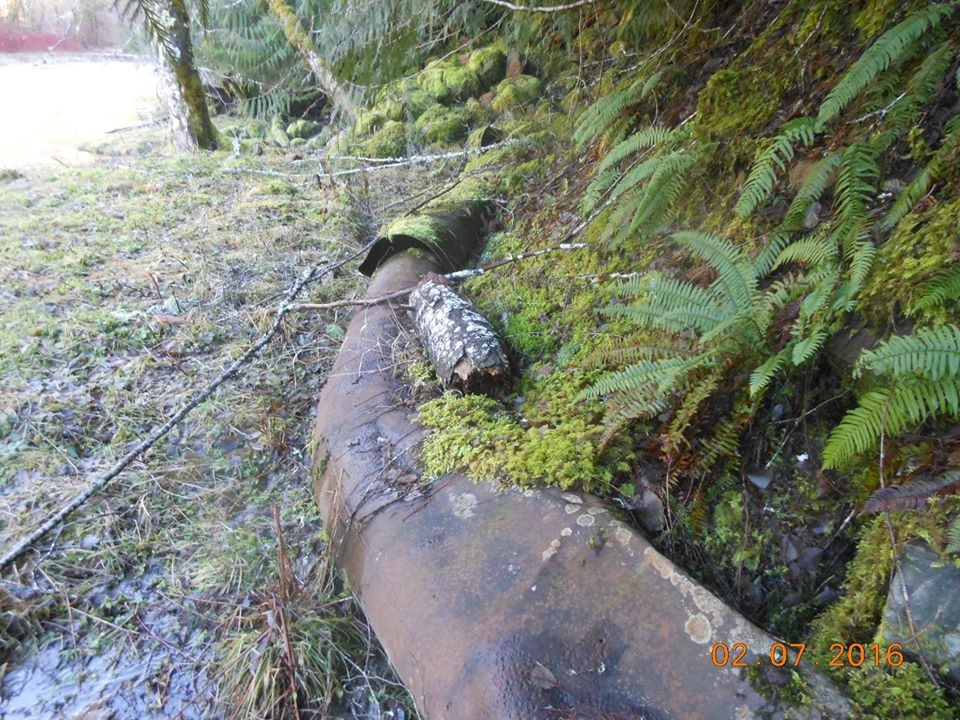
K
Thanks for the pictures Steve. I think the initials at the top of that pole tag are PWPSCO. I'm trying to figure out what they stand for. Maybe Portland Willamette Power & Steam Company? It must be one of the names PGE went by before 1948 (from Wikipedia: "The company name became Portland Electric Power Company (PEPCO) in 1932. It was reorganized in 1948 as PGE.").
Does anyone know?
Is the rest of that PGE history available online anywhere? https://www.trailadvocate.org/scans/PGEHistoryClackamasRiver.pdf
That link for the video doesn't work any longer. 🙁
D
Kirk, it probably says PNWPSCO, for Pacific Northwest Public Services Company, one of PGE's many company names (1930-32). Apparently it was a holding company, with PGE as its electrical subsidiary. See http://www.iinet.com/~retireeski/history.htm
A detailed history of PGE written by a former PGE manager is available at the Estacada library. It's the only copy I know of, and is the source of the "Clackamas River Basin Development" chapter that's posted on this website. Another source for PGE's corporate history is the book "Electrifying Eden" by Craig Wollner, also available through the library.
K
Thanks D., I wasn't sure if that second letter on the pole tag was an N or a W. I'm going with N now that you've found that the company name PNPSCO was active during that time frame.
I'll have to check out that book, it sounds interesting.
Log in to reply.